Tuesday, May 26, 2026

Powering Packaging with Advanced Automatic Bottle Capping Machines


The Growing Demand for Automated Bottle Capping in Modern Packaging

In today's high-speed manufacturing environment, packaging precision is no longer optional — it is a competitive necessity. Across industries from healthcare to dairy to agrochemicals, manufacturers face relentless pressure to increase output, maintain product integrity, and reduce operational costs. At the heart of this challenge lies a deceptively simple yet critically important operation: bottle capping.

Manual bottle capping, once the industry standard, is rapidly revealing its limitations on modern production floors. When workers apply caps by hand, the process introduces a wide range of inconsistencies that can have serious downstream consequences. Caps applied with insufficient torque allow air and moisture to penetrate, accelerating product degradation. Over-tightened caps can crack bottle necks or distort sealing surfaces. In pharmaceutical or food-grade environments, these failures are not merely inconvenient — they represent genuine product safety risks and regulatory liabilities.

The operational inefficiencies of manual capping compound these quality concerns. A skilled operator capping bottles manually can typically process a fraction of what an automated system achieves in the same timeframe. Labor costs accumulate as production volumes scale, and worker fatigue introduces error rates that climb steadily across a shift. The result is a packaging operation that is simultaneously slow, expensive, and unreliable.

"Manufacturers across sectors are realizing that manual capping is not a cost-saving measure — it is a cost-generating liability that limits growth and compromises product quality."

Key Challenges Caused by Manual Capping

     Product leakage due to uneven or insufficient torque application

     Contamination risks from direct human contact with caps and bottle necks

     Dramatically slower throughput that constrains entire production line capacity

     Inconsistent sealing quality producing variable results across batches

     Significantly higher per-unit labor costs that erode margin at scale

These are not minor inconveniences — they represent fundamental barriers to competitive, safe, and scalable manufacturing. Global packaging industry data consistently reflects the recognition that automatic bottle capping machines are the decisive solution to each of these challenges.

  Stage 2 · The Solution 

Introducing IGNITE-I AIR: An Advanced Automatic Bottle Capping Machine

Developed and manufactured by R Technologies, the IGNITE-I AIR is an advanced automatic bottle capping machine engineered specifically to address the challenges that limit manual and semi-automatic capping operations. Designed for integration into continuous production environments, the IGNITE-I AIR represents a significant step forward in packaging automation — combining precision air-operated capping mechanics with user-friendly controls and industrial-grade durability.

At its core, the IGNITE-I AIR automates the entire capping process, from cap placement through to final torque application, without requiring manual intervention at each bottle. Compressed air drives the capping head with consistent, controlled force, ensuring that every cap receives the same precise torque regardless of production speed or operator variability. This air-operated mechanism eliminates the mechanical wear patterns associated with purely motorized systems and delivers repeatable, calibration-stable performance that modern quality management systems demand.

What distinguishes the IGNITE-I AIR from generic capping solutions is its suitability for the specific demands of industries where packaging failure carries real consequences. In pharmaceutical and healthcare manufacturing, even minor deviations in cap sealing can compromise sterility or dosage integrity. In dairy processing, improper capping accelerates spoilage and generates costly returns. In agro-chemical and specialty chemical environments, secure sealing is both a product preservation requirement and a regulatory safety obligation. The IGNITE-I AIR is built with these exacting standards in mind.

Industries Served by the IGNITE-I AIR

     Healthcare — Pharmaceutical vials, syrups, and medical-grade liquid packaging

     Dairy — Milk, yogurt, butter, and dairy product bottles requiring hygienic sealing

     Agro Chemicals — Pesticide, fertilizer, and agrochemical containers with compliance sealing

     Food & Beverages — Sauces, juices, oils, and consumable product bottles

     Specialty Chemicals — Industrial chemical containers requiring precise, leak-proof closure

  Stage 3 · Features & Benefits 

Key Features of the IGNITE-I AIR Automatic Bottle Capping Machine

Automatic Operation

The IGNITE-I AIR operates as a fully automatic unit, eliminating the need for per-bottle manual involvement once the machine is configured for a given production run. This self-contained operation allows production supervisors to allocate labor to higher-value tasks while the machine maintains capping output at consistent throughput rates.

High-Speed Capping Performance

Production throughput is one of the primary metrics by which packaging equipment is evaluated, and the IGNITE-I AIR is designed to deliver strong performance in this critical area. Its high-speed capping capability makes it suitable for packaging lines that demand both volume and precision simultaneously.

Precise Torque Control via Air-Operated Mechanism

The air-operated capping head is the defining technical feature of the IGNITE-I AIR. Unlike purely mechanical systems where torque can vary with component wear or temperature changes, the pneumatic mechanism delivers a calibrated, repeatable force to each cap. Torque settings can be adjusted to suit specific cap types, bottle materials, and product requirements.

Durable Industrial Construction

The IGNITE-I AIR is built using materials and manufacturing standards appropriate for demanding industrial production environments. Its structural components are designed to withstand the mechanical stresses, ambient conditions, and extended duty cycles associated with continuous manufacturing.

Easy Production Line Integration

The IGNITE-I AIR is engineered with production line integration in mind, offering compatibility with standard conveyor systems and upstream filling equipment. This integration-friendly design reduces commissioning time and allows manufacturers to incorporate the machine into both new installations and existing line upgrades without extensive modification.

Low Maintenance Design

Unplanned downtime is among the most costly events in a production environment. The IGNITE-I AIR addresses this concern through a design philosophy that prioritizes accessibility and maintainability. Service points are positioned for easy access, wear components are designed for quick replacement, and extended maintenance intervals keep operational availability high.

User-Friendly Controls

Operator interface design in the IGNITE-I AIR reflects an understanding that packaging lines are operated by technicians with varying levels of equipment familiarity. Controls are intuitive and clearly marked, setup procedures are straightforward, and parameter adjustments can be made quickly without specialized tooling or extended downtime.

Benefits Summary

Benefit

Operational Impact

Relevance

Reduced Product Wastage

Consistent torque eliminates under- and over-capped rejects and leakage-related losses at scale.

All Industries

Increased Productivity

High-speed automatic operation multiplies throughput without proportional increases in labor costs.

All Industries

Better Packaging Consistency

Every bottle on every shift receives the same sealing quality, supporting batch uniformity and QC compliance.

Pharma · Food

Improved Hygiene Standards

Automated capping minimizes direct human contact with bottle openings and cap surfaces.

Dairy · Healthcare

Reduced Manpower Dependency

Labor requirements at the capping station decrease significantly, freeing workforce for value-added tasks.

All Industries

Long-Term Cost Savings

Lower rejection rates, reduced labor costs, and minimal maintenance expenses improve per-unit economics.

All Industries

  Stage 4 · Decision 

Why Choose the IGNITE-I AIR for Your Packaging Operation?

When evaluating automatic bottle capping machines for industrial deployment, procurement teams and plant engineers must weigh performance, reliability, versatility, support infrastructure, and total cost of ownership. The IGNITE-I AIR by R Technologies addresses each of these evaluation criteria with a well-considered combination of engineering quality and operational practicality.

Multi-Bottle Compatibility: Accommodates a broad range of bottle sizes and cap formats, making it adaptable to diverse SKU portfolios without requiring significant retooling between production runs.

Energy-Efficient Operation: Designed for efficient energy consumption, the machine minimizes power draw during continuous operation — contributing to lower utility costs and sustainability objectives.

Customization Options: R Technologies offers customization to accommodate specific production requirements, cap types, bottle configurations, and integration needs unique to individual manufacturing environments.

Strong After-Sales Support: Backed by R Technologies' service infrastructure, customers benefit from responsive technical support, genuine spare parts availability, and expert guidance on machine optimization.

Continuous Production Ready: Engineered for extended duty cycles, making it appropriate for facilities running multi-shift or 24-hour production schedules without sacrificing performance stability.

Trusted Industrial Reliability: R Technologies brings proven experience in packaging machinery design and manufacture, with a track record of delivering equipment that meets demanding standards across multiple industrial sectors.

"The IGNITE-I AIR is not simply a machine — it is a long-term packaging infrastructure investment backed by engineering expertise, industrial-grade materials, and a manufacturer committed to your production success."

For packaging plant owners, pharmaceutical manufacturers, dairy processors, food and beverage producers, chemical manufacturers, and packaging line integrators evaluating their next capping solution, the IGNITE-I AIR offers a compelling combination of precision, productivity, adaptability, and support. It is the automatic bottle capping machine designed for those who cannot afford to compromise on sealing quality.


  Ready to Upgrade Your Capping Line? Contact R Technologies Today 

Reach out to our packaging automation specialists to discuss how the IGNITE-I AIR can be configured for your specific production requirements. Our team is ready to provide technical consultation, product demonstrations, and customized quotations.

R Technologies  |  Packaging Machinery Manufacturer  |  IGNITE-I AIR — Automatic Bottle Capping Machine

Wednesday, May 13, 2026

How Does an Induction Cap Sealing Machine Work? A Step-by-Step Guide for Indian Manufacturers

 If you make products in India—pharma, food and beverages, dairy, agro chemicals, personal care—you know product integrity starts with the cap. One unsealed bottle out there, and customers start doubting everything. Trust, gone. That’s why induction cap sealing machines are pretty much essential now.

Let’s break down how these machines work, step by step—how they actually seal, what happens inside the process, and why so many Indian manufacturers are switching to modern air-cooled models like IGNITE-I AIR from R Technologies for efficient, tamper-evident packaging.


What’s an Induction Cap Sealing Machine?

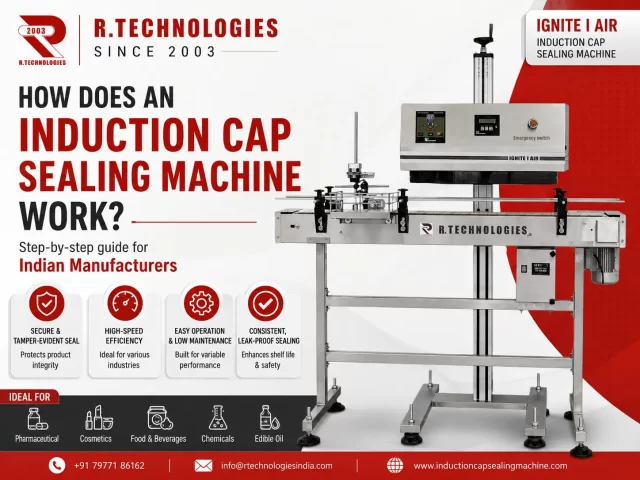
Induction Cap Sealing Machine IGNITE-I AIRThis is a clever device that uses electromagnetic induction to bond a foil liner to the mouth of your container—plastic or glass—without touching the bottle or cap directly. You get a tight, tamper-evident seal that keeps product safe from leaks, contamination, and shady tampering.
Induction sealing doesn’t blast the container with heat or slather it in glue. That’s a win: it’s cleaner, faster, and uses less energy, which is what busy production lines in India need.

So, How Does Induction Sealing Actually Work?

It’s all physics. The machine has an induction coil that creates a high-frequency electromagnetic field. When your bottle—with its specially lined cap—rolls beneath this field, the aluminium foil inside the cap gets hot fast. Why? Eddy currents. That heat melts the polymer bonding layer on the foil, which sticks itself to the rim of the container. Once the bottle leaves the field, the polymer cools and locks everything together—airtight seal, done, in a flash.

No direct heat. No touch. Just the right science.

Running Through the Process—Step by Step

Step-by-Step: How an Induction Cap Sealing Machine Works

  1. Cap Liner Prep

It starts before the bottle meets the machine. Your caps need a multi-layer induction seal liner: foam or pulp backing (stays in cap after sealing), wax (temporary bond), aluminium foil (heats up), and a heat-seal polymer film (bonds to the bottle). Good cap suppliers already include these liners. It’s standard stuff, and Packaging Industry Association of India (PIAI) can help you find the right ones.


  1. Capping

Once filled, bottles head to the capping station. Tighten the cap properly—by hand, semi-auto, or machine. Uneven or loose caps? That’ll lead to failed seals. If you’re running high-speed lines, automatic capping units make sure every cap is snug.


  1. Conveyor into Induction Zone

Bottles move on a belt into the sealing tunnel or under the sealing head (depends on the machine). In machines like IGNITE-I AIR, bottles pass under the induction head at speeds up to 55 feet per minute. Conveyor speed and power output are matched. Too fast? Foil doesn’t heat enough. Too slow? You could melt or damage the cap.


  1. Induction Field Generation

As bottles enter the seal zone, the generator kicks in, energizing the induction coil. The electromagnetic field goes straight through the cap and zeroes in on the foil. The foil heats up quick and melts the polymer. Newer models, like IGNITE digital from R Technologies, use fewer parts and give tighter power control. That means less energy waste, steady sealing, and lower running costs.


  1. Polymer Bonding—Getting That Seal

As the polymer melts, it bonds tight to the rim of the container—HDPE, PET, PP, glass, whatever. At the same time, the wax between foil and backer melts, so when the customer opens the bottle, the backer separates cleanly and leaves the foil sealing the bottle. This all happens in milliseconds. Hundreds—even thousands—of bottles get sealed every hour.


  1. Cooling and Seal Locking

No water cooling here. Bottles leave the field and cool down naturally—the polymer solidifies in seconds. IGNITE-I AIR uses a compact air-cooled system for the generator and coil head—so no water supply or plumbing hassles. That’s a big plus, especially for smaller manufacturers needing a plug-and-play solution.


  1. Seal Inspection and Quality Control

Sealed bottles roll into inspection. Inline detectors catch missing liners, loose or misaligned caps, jammed bottles—you name it. Some machines, like IGNITE-I AIR, offer these as add-ons:

  • Missing foil detectors
  • Cross cap or loose cap sensors
  • Reject mechanisms that automatically remove bad bottles
  • Jam detectors, lights, and alarms

For pharma or food, these quality features are mandatory for GMP compliance.

  1. Downstream Handling

Bottles that pass inspection move on for labelling, batch coding, packaging, or dispatch. The sealed foil now acts as a visible tamper barrier—anyone tries to mess with it, you’ll see it right away.


Why IGNITE-I AIR Makes Sense for Indian Manufacturers

The IGNITE-I AIR from R Technologies (Navi Mumbai) was designed with Indian shops in mind. Here’s what it brings:


  • Standard Indian power (200–240V)
  • 1 kW output: handles most production speeds
  • Universal coil for cap sizes from 20mm to 160mm (switch sizes with no coil changes)
  • 55 feet/minute line speed
  • Air-cooled (no water needed, easier maintenance)
  • 60 kg—easy to move around
  • Smart digital controls, alarms, and indicator panel

That universal coil means you can run multiple SKUs back to back, no downtime swapping coils.


Who Uses Induction Cap Sealing Machines?

These aren’t industry specific—they’re everywhere:

  • Pharmaceuticals: needed for tamper-evidence compliance
  • Food & Beverages: sauces, oils, juices, dairy
  • Cosmetics & Personal Care: shampoos, lotions, serums
  • Agro and Petro Chemicals: hazardous liquids
  • – Water & Dairy: high-speed, hygiene-focused lines
  • Automotive: lubricants, coolants, fluids


What Problems Does Induction Sealing Solve?

Still doing manual foil application or liner-less caps? That usually leads to:

  • Leaks during road transit
  • Tampering and loss in pharma or FMCG
  • Contamination from humidity and air
  • Rejection and recall headaches with distributors

Induction sealing gets rid of all these issues—in one easy step, without slowing down your production.

Picking the Right Cap Sealing Machine—What to Look For

Think about:

  • Line speed: match your production pace
  • Cap size range: make sure the coil fits all your bottle caps
  • Cooling system: air-cooled wins if your floor’s dusty or tight on space
  • Power requirements: check your facility’s specs
  • Accessories: consider detectors and rejectors, especially for pharma
  • – After-sales support: pick a manufacturer with local service

R Technologies (MIDC Turbhe, Navi Mumbai) offers everything from handheld units to fully automatic machines, with after-sales support across India.


FAQs


Can one machine seal different cap sizes?

Absolutely. IGNITE-I AIR’s universal coil covers 20mm to 160mm caps with zero coil changes.

Can induction sealing work on glass bottles?

Yes, it works on glass, HDPE, PET, PP—any rigid container, as long as it has the right liner.

How do I know if the seal is good?

Look for a flat, smooth, wrinkle-free seal that sticks evenly to the bottle mouth. Inline accessories can inspect each bottle for you.

Does the machine need water for cooling?

Nope. IGNITE-I AIR is air-cooled, no plumbing required.

What’s the typical ROI?

Most mid-volume operations recover the investment in 12–24 months through fewer leaks, less rejection, and lower tamper claims. Ask R Technologies for numbers tailored to your business.


Bottom Line

Induction cap sealing machines are a smart move for Indian manufacturers. They lock in tamper-evident, airtight seals at speed—no water, minimal energy, low hassle. From getting the liners ready, through electromagnetic bonding, to final inspection, everything runs reliably and repeatably.

If you’re after a compact, efficient system, IGNITE-I AIR from R Technologies is a solid pick. Local manufacturing, service, and proven performance in pharma, FMCG, dairy, chemicals—you name it.

Ready to get started? Call R Technologies at +91 98204 91182 or check out inductioncapsealingmachine.com for a demo or quote.

Wednesday, May 6, 2026

Manual Induction Foil Sealing Machine: The Complete Guide for Modern Packaging

A comprehensive look at how Manual Induction Foil Sealing Machines work, their key features and benefits, and why R Technologies remains the go-to Manual Induction Sealing Machine Manufacturer in India for over two decades.
In today's competitive packaging landscape, product integrity and consumer trust are everything. Whether it's a bottle of pharmaceutical syrup or a jar of premium skincare cream, the seal on a container is often the first line of defense against contamination, tampering, and spoilage. This is precisely where a Manual Induction Foil Sealing Machine steps in as an indispensable tool for manufacturers and packagers alike. Induction sealing technology has transformed how industries across India and the world ensure product safety. Among the pioneers of this technology in India is R Technologies — a company established in 2003 that has dedicated over two decades to designing, manufacturing, and supplying high-performance induction sealing solutions. From small-scale operations to large industrial set-ups, R Technologies has become synonymous with precision, reliability, and innovation in the foil sealing domain. This blog article explores everything you need to know about the Manual Induction Foil Sealing Machine — how it works, its standout features, its diverse applications, and why R Technologies is the preferred Manual Induction Sealing Machine Manufacturer in India.

What is a Manual Induction Foil Sealing Machine?

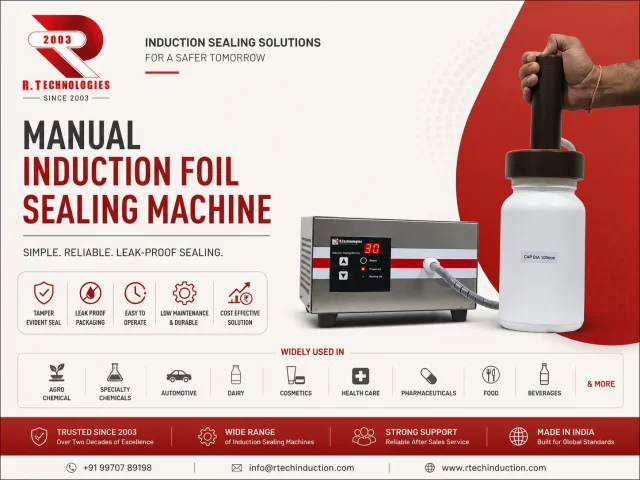
Manual Induction Foil Sealing Machine — also commonly referred to as a Cap Sealing MachineFoil Sealing Machine, or Induction Cap Sealer — is a portable, hand-operated device used to create hermetic (airtight) seals on containers using electromagnetic induction technology. Unlike automated conveyor-based sealing systems, the manual variant is designed for flexibility. The operator simply places the sealing head over a capped bottle or container, and within seconds, the foil liner inside the cap is bonded permanently to the container's mouth — without any direct contact between the machine and the container. These machines are widely used for sealing plastic bottles, glass jars, aluminum containers, and HDPE containers across a variety of industries where product safety, shelf life extension, and tamper-evidence are critical requirements.

Working Principle

Understanding how a Foil Sealing Machine works helps appreciate the engineering elegance behind the process. The working principle of induction sealing involves three core physical phenomena: electromagnetic induction, eddy currents, and heat conduction.
  1. Container Preparation:The container is filled with the product and capped with a closure that has a foil liner (induction seal liner) placed inside it. This liner typically consists of multiple layers — a backing layer, a wax layer, an aluminum foil layer, and a polymer sealant film.
  2. Electromagnetic Field Generation:When the sealing head of the manual induction machine is brought close to (or placed over) the capped container, the machine generates a high-frequency electromagnetic field.
  3. Eddy Current Induction:This electromagnetic field penetrates the non-metallic cap and induces eddy currents in the aluminum foil layer of the liner. These rapidly alternating currents cause resistive heating in the foil.
  4. Heat Conduction & Bonding:The heat generated in the aluminum foil melts the wax layer (which is absorbed by the backing layer) and simultaneously melts the polymer sealant film on the underside of the foil, bonding it permanently to the rim of the container.
  5. Seal Formation:Upon removing the sealing head, the melted polymer cools rapidly and forms a strong, tamper-evident, hermetic seal. The backing layer and wax remain in the cap, while the foil disc stays bonded to the bottle mouth.
Non-Contact Technology: The most remarkable aspect of induction sealing is that the machine never physically touches the product or the container. The sealing is achieved purely through the electromagnetic field — making it hygienic, fast, and consistent.

Key Features

R Technologies' Manual Induction Foil Sealing Machines are engineered to deliver consistent, reliable performance across diverse packaging environments. Here are the standout features:

Handheld & Portable Design

Compact, lightweight form factor allows operators to move freely across the production floor with ease.

Adjustable Power Settings

Variable power control ensures optimal sealing for different foil thicknesses and container materials.

Tamper-Evident Sealing

Produces permanent, tamper-proof seals that are immediately visible if compromised — building consumer confidence.

Wide Container Compatibility

Works with plastic, glass, HDPE, and aluminum containers of varying neck diameters and shapes.

Rapid Sealing Speed

Seals containers in 1–3 seconds per unit, making it highly efficient for small to medium production runs.

Overheating Protection

Built-in thermal protection circuits prevent damage to the machine and ensure long operational life.

Standard Power Supply

Operates on standard 220V/50Hz power supply — no specialized electrical infrastructure required.

Low Maintenance

Robust construction with minimal moving parts translates to low downtime and easy serviceability.

Multiple Head Sizes

Available with interchangeable sealing heads to accommodate different cap sizes from 20mm to 120mm.


Benefits of Using a Manual Induction Foil Sealing Machine

Investing in a quality Induction Cap Sealing Machine from R Technologies offers a host of tangible benefits for your business and your end consumers:

For Product Manufacturers

  • Extended Shelf Life: Airtight induction seals prevent oxidation, moisture ingress, and microbial contamination — significantly extending product shelf life without preservatives.
  • Reduced Product Loss: Hermetic sealing eliminates leakage during transport and storage, cutting down on waste and financial losses.
  • Compliance Ready: Tamper-evident seals help manufacturers comply with packaging regulations in pharmaceutical, food, and chemical sectors.
  • Cost-Effective Investment: Manual induction sealers offer a low-cost entry into professional induction sealing with minimal infrastructure requirements.
  • Versatility: A single machine can handle a wide range of container types, sizes, and cap styles — ideal for manufacturers with diverse product lines.
  • No Heat Damage to Product: Since heat is generated only in the foil liner (not the container or product), there is zero risk of thermal damage to heat-sensitive formulations.

For End Consumers

  • Clear visual indication that the product has not been tampered with
  • Confidence in product freshness and purity at the time of purchase
  • Protection against adulteration and counterfeiting

Industry Applications

The versatility of R Technologies' Foil Sealing Machine makes it the ideal cap sealing solution across a wide spectrum of industries. Below are the key sectors that rely on manual induction sealing technology:

Pharmaceuticals & Healthcare

In the pharmaceutical sector, product integrity is non-negotiable. Manual induction sealers are used to seal bottles containing tablets, capsules, syrups, and liquid medicines. The tamper-evident foil seal assures patients and healthcare providers that the product has not been adulterated — a regulatory requirement in many markets including India (as per CDSCO guidelines) and internationally.

Food & Beverages

From cooking oils and spices to sauces, honey, and nutritional supplements, food-grade induction sealing preserves freshness, prevents leakage, and enhances consumer trust. The airtight seal slows oxidation and rancidity, keeping food products fresh for longer without chemical preservatives.

Cosmetics & Personal Care

Creams, lotions, serums, shampoos, and other cosmetic products require reliable sealing to prevent evaporation of volatile ingredients and contamination. A professional cap sealing machine ensures the product the customer opens at home is exactly as it left the factory.

Agrochemicals & Specialty Chemicals

Pesticides, herbicides, fertilizers, and industrial chemicals demand robust sealing to prevent leakage of hazardous materials during transport and storage. Induction seals provide a reliable barrier that stands up to the rigors of the chemical supply chain — protecting handlers, consumers, and the environment.

Automotive

Engine oils, lubricants, coolants, and automotive fluids are commonly sold in induction-sealed bottles. The foil seal assures end users and fleet operators that the product is pure and uncontaminated — critical in an industry where product adulteration can cause serious engine damage.

Dairy Products

Dairy companies use induction sealing for yogurt, flavored milk, ghee, and other dairy products to extend refrigerated and ambient shelf life, prevent spillage, and meet food safety standards.  

Why Choose R Technologies?

When it comes to selecting a Manual Induction Sealing Machine Manufacturer in India, R Technologies stands apart through a combination of experience, quality, and customer-centricity. Here's what sets them apart:

20+ Years of Expertise

Founded in 2003, R Technologies brings over two decades of focused experience in induction sealing technology.

ISO-Grade Manufacturing

Machines are built using premium-grade components with stringent quality control at every stage of production.

Made in India

Proudly Indian — supporting the Make in India initiative while delivering world-class packaging machinery.

Pan-India Customer Base

Thousands of satisfied clients across pharmaceutical, chemical, food, and cosmetics sectors across India.

After-Sales Support

Dedicated service team ensures prompt technical assistance, spare parts availability, and preventive maintenance.

Complete Sealing Solutions

Offers a full range from handheld manual sealers to semi-automatic and fully automatic conveyor sealing systems.

R Technologies also provides customized sealing solutions tailored to specific production environments, bottle neck sizes, and throughput requirements — ensuring every client gets a machine that fits their exact needs, not just a generic off-the-shelf product. Their team of trained engineers collaborates closely with clients during the installation and commissioning phase, offering hands-on training to operators and maintenance staff — minimizing the learning curve and maximizing machine uptime right from day one.    

Wednesday, April 29, 2026

Induction cap sealing machine: the complete guide to tamper-proof, leak-resistant packaging

detailed look at how induction cap sealing works, why manufacturers worldwide rely on it, and what makes R Techologies machines the benchmark for perfect seals — every time.


When consumers pick up a medicine bottle, a bottle of juice, or a jar of cosmetics, the first thing that signals safety and quality is the seal. An unbroken, tamper-evident seal tells them the product is exactly as it left the factory. For manufacturers, that assurance begins with the right induction cap sealing machine.

This guide covers everything you need to know — from the science behind induction sealing technology to the cap liner's structure, the sealing process step by step, and the measurable business benefits of choosing induction over conventional methods.


What is quality and safety in packaging?

Whether the product is a pharmaceutical, a beverage, or a cosmetic, packaging must meet a high bar: no leaks, no contamination, tamper evidence clearly visible, and ingredients preserved throughout the supply chain.

The right cap sealing solution must also be environmentally responsible, cost-efficient, and suited to the container it protects. Induction cap sealing satisfies all of these requirements — making it the industry's preferred method for primary packaging across sectors.


What is an induction cap sealing machine?

An induction cap sealing machine uses electromagnetic induction to bond a foil liner to the mouth of a container — without any physical contact between the machine and the cap. As a filled, capped bottle passes beneath the sealing head, a high-frequency magnetic field generates eddy currents in the aluminium foil inside the cap. This heats the foil rapidly, melting the polymer coating and creating an airtight, hermetic bond with the container's rim.


Key technical insight

The sealing process is entirely non-invasive. The cap stays closed throughout; the product inside is never exposed to heat, pressure, or contamination. Both plastic and glass containers — across virtually every cap size — can be sealed using this method.

The result is a tamper-evident foil seal that consumers can see and feel: if the seal is broken, they know immediately. This is why induction sealing machines are mandated in pharmaceutical and food-grade packaging across global markets.


How does the induction sealing process work?

1 Cap with induction liner is applied

A standard cap containing a multi-layer foil liner is torqued onto the filled container at the capping station.

2 Container passes beneath the sealing head

The conveyor moves the capped container through the electromagnetic field of the induction sealing head — no contact required.

3 Magnetic field generates eddy currents

The high-frequency field induces eddy currents specifically in the aluminium foil layer of the liner, heating it in milliseconds.

4 Wax melts and foil releases from cap

Heat transfers to the wax layer, which melts and absorbs into the pulpboard — freeing the foil to bond with the container mouth.

5 Polymer coating bonds foil to container

The polymer film on the underside of the foil melts and fuses permanently with the container rim, creating a hermetic seal.

6 Seal cools and sets instantly

Containers continue down the line fully sealed, tamper-evident, and ready for labelling, inspection, and distribution.


What is a cap sealing liner?

The induction sealing liner is a precisely engineered multi-layer assembly inside the cap. Each layer has a distinct function, and all four must work in concert to produce a reliable seal.

Pulpboard

Soft paper layer bonded to the cap interior; supports the liner stack and retains wax.

Wax

Melts during induction heating and is absorbed into the pulpboard, releasing the foil downward.

Aluminium foil

The active sealing element — heats via eddy currents and forms the airtight barrier on the container mouth.

Polymer film

Melts and permanently bonds the foil to the container rim, completing the hermetic seal.


After the seal is formed, the pulpboard and wax remain inside the cap, acting as a comfortable reclosure liner. The foil stays on the bottle mouth — visible proof of an intact product.


Why choose induction cap sealing?

The advantages of induction sealing technology extend to both manufacturers and end consumers. Here's why it consistently outperforms pressure-sensitive, heat-conduction, and adhesive-based sealing alternatives:


Tamper-evident

A broken foil seal is immediately visible — consumers can verify product integrity before first use.

Leak-resistant

Hermetic airtight bond prevents leakage and spillage throughout distribution.

Assured quality

Ingredients stay intact, unoxidised, and shelf-stable — exactly as formulated.

Longer shelf life

Airtight protection against oxygen, moisture, and contamination extends product freshness significantly.

Higher productivity

Contactless, high-speed operation integrates seamlessly into automated packaging lines.

Eco-friendly

Energy-efficient induction process with low waste and no harmful emissions.

Cost-effective

Low operating costs, minimal maintenance, and reduced product waste drive down total cost of ownership.


Industries that rely on induction cap sealing

Pharmaceuticals — tamper-proof drug and supplement packaging meets strict regulatory and GMP standards globally.

Beverages & food — freshness and contamination prevention from production to consumer, extending shelf life considerably.

Cosmetics & personal care — airtight seals prevent oxidation, maintain product efficacy, and protect brand reputation.

Chemicals & agrochemicals — dangerous liquid products are safely contained, preventing leaks and ensuring worker safety.

Frequently asked questions

What containers work with an induction cap sealing machine?

Most plastic containers (HDPE, PET, PP, LDPE) and glass bottles are compatible, provided the cap includes a correctly configured induction liner. R Technology machines accommodate a wide range of container diameters and cap sizes.

Does the induction sealing process affect the product?

No. The process is entirely non-invasive. Only the aluminium foil liner is heated by the eddy current field. The container remains capped, and the product is completely unaffected by heat or the electromagnetic field.

How is induction sealing different from heat sealing?

Heat sealing uses direct physical contact with a heated element. Induction sealing is contactless — no part of the machine touches the cap. This means higher speeds, more consistent results, less maintenance, and zero contamination risk from direct contact.

What production speeds can induction cap sealing machines achieve?

Depending on the model, induction cap sealing machines can process anywhere from a few hundred to several thousand containers per hour, making them suitable for small-batch specialty manufacturing and high-volume automated lines alike.

Is induction sealing compliant with food and pharmaceutical regulations?

Yes. Induction sealing is widely accepted and often required by regulatory bodies including FDA, EU GMP, and FSSAI for pharmaceutical and food-grade packaging, precisely because it provides verifiable tamper evidence and hermetic containment.


R Technologies is a prominent provider of sealing systems for over 2+ decades. We have a selection of induction sealing equipment that may meet your various demands. When it comes to boosting your business, there is no better place to go than here for trustworthy and cost-effective options. To receive a FREE quote on our machines, contact us now.


Powering Packaging with Advanced Automatic Bottle Capping Machines

  The Growing Demand for Automated Bottle Capping in Modern Packaging In today's high-speed manufacturing environment, packaging preci...